

How to build a three story office building in the Philippines in 30 days?
Against the backdrop of rapid urbanization in the Philippines, three-story office buildings have become a popular choice for SMEs, startup parks, and community service centers due to their balance of space efficiency and construction costs. Traditional brick-and-mortar structures suffer from drawbacks such as long construction periods, weak earthquake resistance, and poor spatial flexibility. Canglong Steel Structure, with its modular solutions, provides Philippine clients with a 30-45 day rapid delivery, highly earthquake-resistant, and low-cost three-story office building solution, successfully implemented in multiple projects in Manila and Cebu.
Why Choose Steel Structures?
The Philippines is located in the Pacific Ring of Fire (frequent earthquakes) and has a tropical monsoon climate (high temperature and humidity). Three-story office buildings must meet three core requirements:
Earthquake Resistance: Withstand earthquakes of magnitude 6-7 (common in the Philippines).
Rapid Construction: Shorten construction time to meet business needs; traditional structures take 2-3 times longer than steel structures.
Flexible Space: Open-plan offices, private offices, meeting rooms, and other functional areas can be freely adjusted.
Steel structures, with their light weight, high strength, and rapid construction, perfectly meet the above requirements, making them the preferred choice for three-story office buildings in the Philippines.
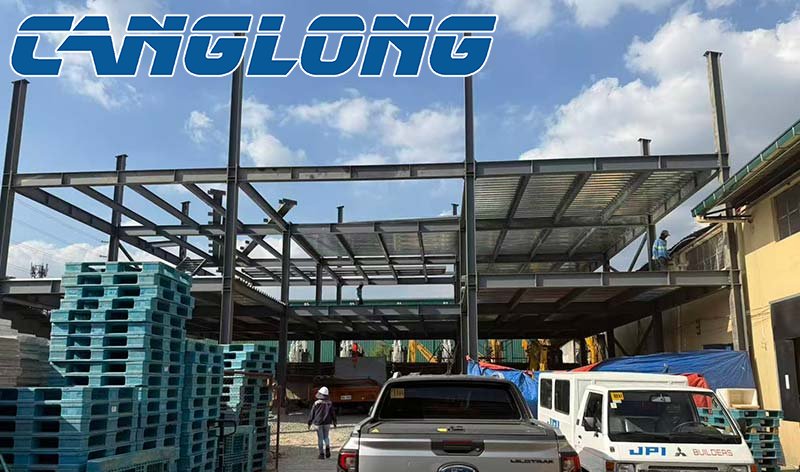
Canglong Steel Structure Design Scheme
Canglong Group, addressing the standardized requirements of a three-story office building, adopted a classic steel structure system consisting of a beam-column frame, purlin supports, and floor decking. The core materials and configurations are as follows:
1. Beam-Column System: H-shaped steel
Materials: Main beams and columns are made of Q355B grade H-beams (cross-sectional dimensions customized according to span), with wide flanges and thin webs, combining bending stiffness with convenient node connections.
Advantages:
The Philippines is a seismically active region. The H-beam frame, through a strong column-weak beam design, prioritizes beam yielding and energy dissipation during earthquakes, protecting the main structure.
Factory prefabrication accuracy reaches ±2mm, with on-site bolt connections (no welding required), avoiding the influence of high-temperature environments and improving installation efficiency by 60%.
2. Roof and Wall Support: C-shaped Steel Purlins
Materials: Roof purlins and wall beams are made of C160×60×20×2.5mm C-shaped steel (galvanized layer ≥275g/m²), spaced 1.2-1.5 meters apart.
Advantages:
C-shaped steel has a C-shaped cross-section, superior bending resistance compared to angle steel, and weighs only 60% of angle steel, reducing transportation and hoisting costs.
The galvanized layer and passivation treatment resist corrosion from the high humidity and saltiness of the Philippine air, ensuring a lifespan of over 25 years.
Connected to H-shaped steel columns using self-tapping screws and washers, providing wind resistance up to level 12.
3. Floor Load-Bearing Capacity
Solution: All three floor slabs will use CL51-305-915 open-faced floor decking (1.0-1.2mm thickness, Z180 galvanization), topped with φ8@200 steel mesh, and then poured with 100-120mm thick C25 concrete.
Advantages:
Floor decking replaces traditional wooden/steel formwork, eliminating the need for formwork erection and removal, reducing single-floor slab construction time from 7 days to 2 days.
The profiled steel sheet ribs and concrete form a combined load-bearing structure, achieving a floor slab load-bearing capacity of 5kN/m², and providing better sound insulation than pure concrete slabs.
Reinforcing ribs are installed at the edges of the floor decking to prevent concrete shrinkage cracks caused by the high temperatures in the Philippines.
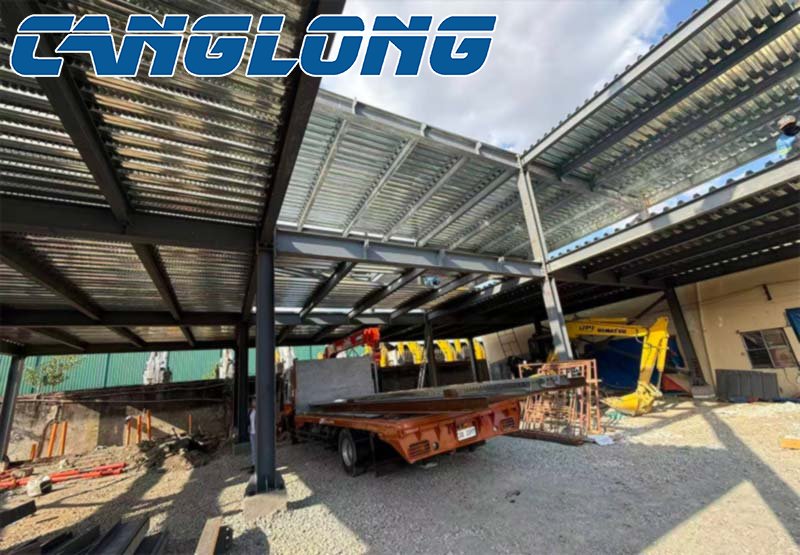
Canglong One-Stop Service
Canglong provides Philippine clients with a full-process service encompassing design refinement, material production, and remote guidance. Key highlights include:
Customized Design: Optimizing beam and column layouts based on client needs (e.g., whether a mezzanine is required, facade design), providing free 3D renderings and structural calculations, compliant with Philippine NSCP seismic codes.
Complete Material Supply: One-stop delivery of H-beams (cut, drilled, shot-blasted for rust removal pretreatment), C-beams (galvanized finished product), floor decking (custom width according to span), and connectors (high-strength bolts, self-tapping screws), avoiding the challenges of coordinating with multiple suppliers.
Local Support: The Philippine team provides remote installation guidance, assisting local construction teams to ensure compliance with Philippine building regulations (such as DOLE safety standards).
Latest News
-
Why are PU panels the preferred choice for factory construction in Thailand?
-
How to build a three story office building in the Philippines in 30 days?
-
Cold chain integration and steel structure solutions in Argentine beef exports
-
Canglong steel structure solution for a 5000㎡ factory in Chile
-
Advantages of metal surface insulated sandwich panels for steel plants
-
How to achieve 95% material recyclability in steel structure buildings?


